

On growth, the Governor said the prospects in the last few months have improved.

India's economic growth rate is expected to be at least 6 per cent in the 2013-14 fiscal, Prime Minister's Economic Advisory Council (PMEAC) Chairman C Rangarajan said.

The wholesale prices-based index stood at 4.72 per cent during the corresponding week previous year.

The government will unveil the Consumer Price Index data and the Wholesale Price Index data for August on Monday.

RBI has kept interest rate unchanged at 8 per cent since January

Inflation based on the Wholesale Price Index cooled to a 5-year low of 1.77 per cent in October driven by softening prices of fuel and food items.

According to the global research firm, though a sharp fall in WPI inflation and negative growth in Industrial production is exerting pressure on the RBI to cut rates, the quantum of rate cut will be more important than the timing.

In February last year, it was (-)2.17 per cent.

In the second week of December, the food inflation was at 18.65 per cent. Potato prices more than doubled while pulses became costly by over 41 per cent over the last year.

Rajan has been facing continuous attacks by Bharatiya Janata Party MP Subramanian Swamy and some other sections, who have alleged that he has failed to lower interest rates and boost the economy

GDP growth in November is the second-highest since January 2012 when it had expanded 5.7%.
The rupee bounced back by 26 paise to end at 59.93 against the American currency on Friday as exporters and some banks sold dollars.
After falling for two weeks in a row, inflation once again firmed up marginally to 6.10 per cent for the week ended February 24 against 6.05 a week ago.

If credit is not going to flow in response to a policy rate cut, while inflationary pressures, as well as expectations, may be stoked, a rate cut may not be appropriate at this point

The WPI has been in the negative zone since November.
The previous low was recorded at 5.69 per cent for the week ended February 23, 2008. The index of food articles group declined by 0.7 per cent as prices of jowar fell by five per cent, fruits and vegetables by three per cent, eggs and bajra by one per cent each.

Oil and select auto heavyweights bore the brunt of selling pressure; ONGC, RIL, Tata Motors, M&M key losers.

The rupee resumed lower at 61.15 per dollar as against the last weekend's level of 61.07 at the Interbank Foreign Exchange market and hovered in the range of 61.15 and 61.28 before quoting at 61.24 per dollar at 1030 hours.
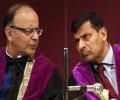
Rajan had cautioned against any deviation from the fiscal discipline path.
Inflation fell below the five per cent mark to stand at 4.85 per cent for the week ended May 26 from 5.06 per cent in the previous week, as the prices of essential food items like pulses and fruits and vegetables declined.
Some say the MPC will raise the rate, while others are of the view that there is already de facto interest rate tightening through rising bond yields, which might prompt the central bank to go for a pause.
The chief statistician feels there should be a rebound after companies integrate and adopt the GST system

To cut interest rates, the central bank head has to open up a debate on inflation target revision.
RBI is scheduled to announce mid-quarter review of monetary policy for 2013-14 on June 17.

Stock market barometers Sensex and Nifty ended marginally higher on Monday as rise in wholesale inflation capped early gains despite a positive trend in global markets. The 30-share index settled 32.02 points or 0.05 per cent higher at 60,718.71 with half of its constituents ending in green. The broad based Nifty edged up 6.70 points or 0.04 per cent to close at 18,109.45.

If imputed inflation for April and May is used, then you have inflation of over 6 per cent for two consecutive quarters, which is a worrying signal for the RBI.

CPI-based inflation on a (year-on-year) basis has come down from 8.59 per cent in April 2014 to 7.80 per cent in August 2014.

'The finance ministry and the RBI will never admit to the difficulties in the economy because if they do so, it will adversely impact the financial markets, etc.' 'They like to present a rosy picture that everything is fine and under control.'

It would be beneficial for the economy to hold on to high interest rates till inflation numbers are under control.

Growth in China's consumer inflation slowed than market expectation to 1.6 per cent in September, the lowest since January 2010, according to the official data released on Wednesday.

'The robust tax collections give the finance minister a fair amount of headroom for an expansionary fiscal policy.'

It is unlikely that the RBI will drop rates until the inflation rate drops below five per cent.

Top gainers in the Sensex pack included ICICI Bank, Infosys, Bajaj Finance and HDFC Bank, rising up to 2.67 per cent.
The government is working towards further review and simplification of the foreign direct investment (FDI) policy to facilitate the proposed initial public offering (IPO) of the Life Insurance Corporation (LIC), Department for Promotion of Industry and Internal Trade (DPIIT) secretary Anurag Jain said on Thursday. The final decision will be taken by the Cabinet. The industry department is working together with the finance ministry's department of financial services (DFS) and department of investment and public asset management (DIPAM) towards a successful listing of the life insurer on the domestic bourses, which is expected to be the largest in India.

The government has taken a number of steps to stem the depreciation of rupee including moderation in demand of non-essential imports and enhancing supply of capital flows, Finance Minister P Chidambaram said.
.jpg)
Food and fuel inflation in India have remained high for several years, the paper said, adding to durably reduce the current high inflation, the monetary policy stance needs to remain tight for a considerable length of time.

WPI inflation even breached psychological level of 0% in Nov.

Industry bodies called for implementation of measures announced in the Budget to arrest inflation, saying these would pave the way for a stable inflation regime.

After fighting inflation for more than two years, Reserve Bank of India (RBI) Governor Duvvuri Subbarao finally managed to bring it below the five per cent level - the tolerance level of the central bank - in FY14.
 © 2026 Rediff.com - Advertise with us - Disclaimer - Privacy Policy - Sitemap - Feedback - About us - Terms of use - Grievances